Investigating History
CLEARING JAPANESE MINES AT CLARK FIELD, LATE JANUARY 1945
Clark Field, with its airfields proper comprising of 7 airstrips and its satellite airfields from Bamban to Mabalacat, Angeles, Porac, Floridablanca and Tarlac (Tarlac Province), was one of the biggest air center in the Pacific and a main tactical and training military air aviation facilities. With the start of the Philippine Liberation Campaign at the Leyte Landing in October 1944, the 4th Air Army of the Imperial Japanese Army and the Navy begun air reinforcements. The 4th Air Army had additional air regiments for fighters and bombers for both the 2nd and 4th Air Division while the Imperial Japanese Navy had made reinforcements on October 22-23 with the arrival of the 2nd Air Fleet.
From Clark Air Center, 1st and 2nd Air Fleet, with the cooperation of the 4th Air Army, conducted massive air operations in Leyte Gulf on October 23 and 24, 1944 with hundreds of aircraft participating from Clark, to hamper then on-going American operations. At the same time, it was at Mabalacat, where the first Kamikaze Special Attack was organized by Vice-Admiral Onishi Takijiro of the 1st Air Fleet. Soon, units from the 1st Kamikaze Special Attack Force were operating from the airfields of Mabalacat and Clark Field, then followed with the inclusion of the tactical organizations from the 2nd Air Fleet that were operating from the satellite airfields including Angeles and Porac Airfields.
The airfields of Clark became critical in the air operations of both the 4th Air Army and the Japanese Navy’s 1st Combined Air Fleet. However, as the war of attrition continued and both the Japanese Air Army and Navy’s tactical and special attack units were destroyed as effective units in the latter part of December 1944, the surviving aircraft from both Army and Navy Air Services were ordered to escape to the north in Echague and Tuguegarao and Taiwan. Pilots from the 1st and 2nd Air Fleet were ordered evacuated to Echague and Tuguegarao starting January 7, 1944, including those members of the Special Attack (Kamikaze).
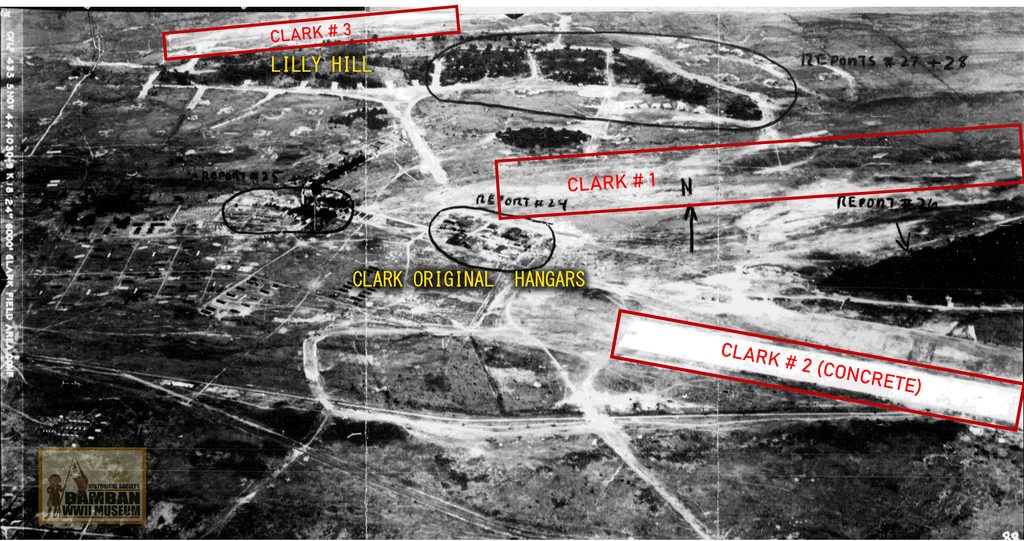
Runway No. 2 (concrete airstrip) and Runway No. 1 (also Clark Central).
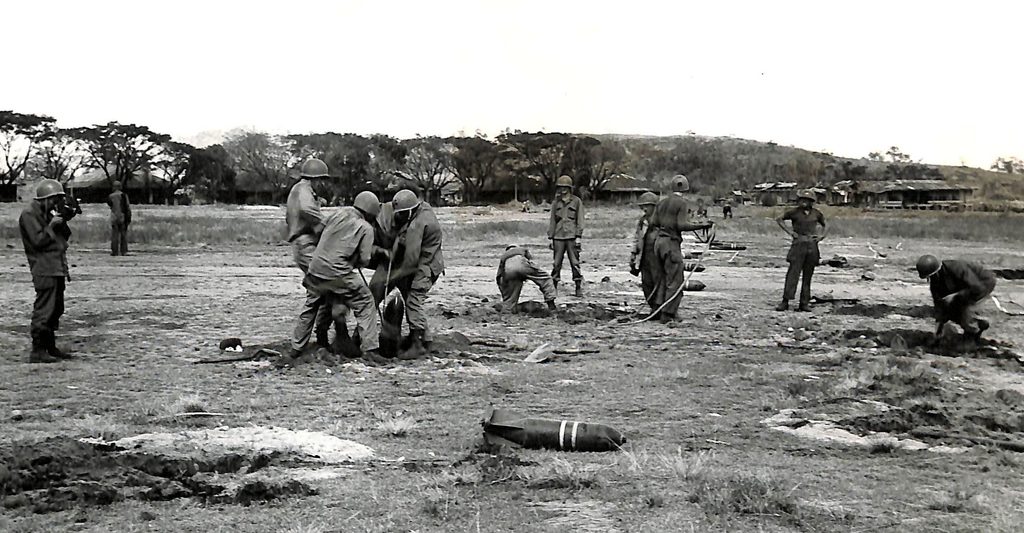
It was possible that the photograph of the clearing mines
undertaken was in front of the Lilly Hill, which was the Clark Runway No. 1.
NARA Photo.
Around January 20-22, 1945, the various airfield battalions and companies from the satellite airfields were ordered to concentrate on Clark Field Proper. The airfields at Clark Air Center were ordered to be destroyed by the airfield units and mines were laid on these airfields with Army and Nayv aerial bombs from 15 to 150 kilograms, where Keibi Unit of the airfield battalion and companies in charge of each airfield set-up the aerial bombs planted in the ground nose up. All the airfields of Clark Proper, from Clark Nos. 1 to 7 runways became defensive lines of the Eguchi Detachment (10th Air Sector, 4th Air Division, 4th Air Army), fortified with infantry, rifle, machine gun and mortars.
The battle for the capture of Clark Field begun with the arrival of the contingents from the 160th Infantry, 40th Division on January 25, 1944, on the northern sector of the Mabalacat West Airfield and the 37th Division’s 129th Infantry on January 28, 1945, coming from the main road at the Camp Del Pilar and into Clark Runway Nos. 1, 2 and 4. The 37th Division committed the 145th and the 129th Infantry, with the 160th Infantry of the 40th Division conducting combat operations on the northern and northwestern edges of the Clark Field.
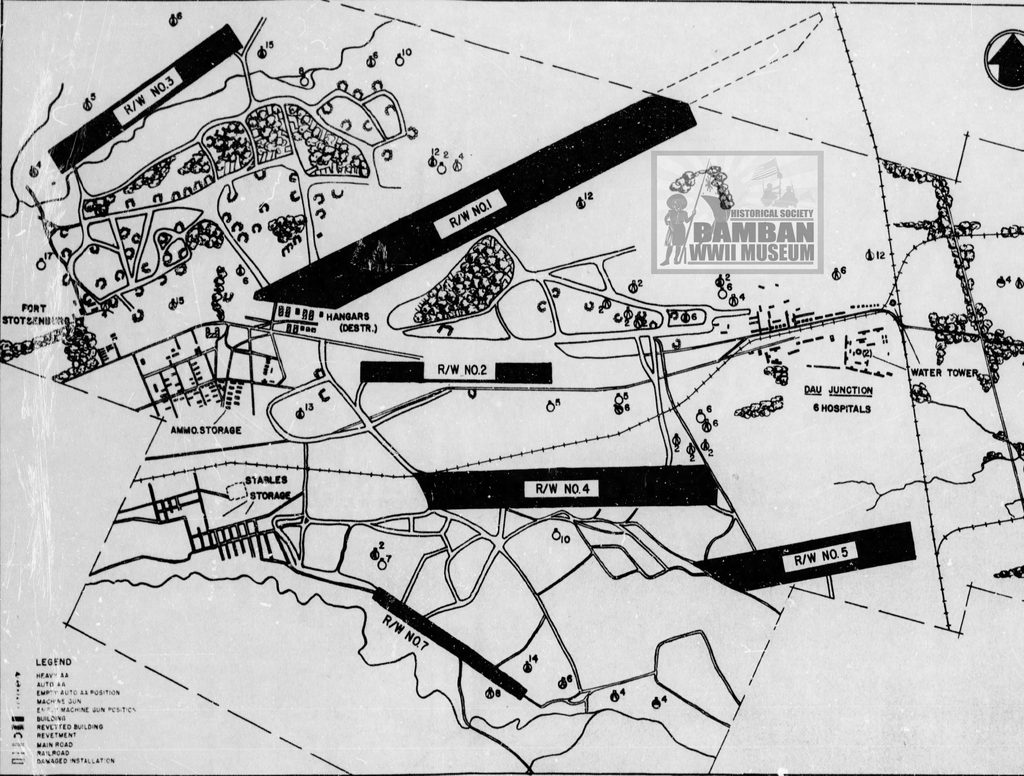
indicating Runway No. 1 on the southeast of Lilly Hill.
NARA Photo.
During combat operations on January 29, 1945, by the 129th Infantry on Clark Runway Nos. 1, 2 and 4, the airfields were mined extensively, and a couple of the M-4 Sherman tanks (from the 754th Tank Battalion) were destroyed by these mines. Actions were already undertaken by the 37th Division, assigning the 117th Engineers for the mine clearing operations at Clark Field and removing the aerial bombs (15-to-150-kilogram bombs). Operations for mine clearing by the 117th Engineers first by disarming the bombs by removing the aerial fuse and then dragging out from their position by using trucks with modified frames. At the end of the mine clearing operations, there were 1,349 mines that were taken out by the 117th Engineers at Clark Field.
A photograph of the mine clearing operation at Clark Field was taken by the US Army Signal Corps dated January 31, 1945, showing crew of the 117th Engineers dragging out the aerial bombs from the holes. The place where the event took place must have been part of the airfield of Clark Runway No. 1 (at the western edge near the burnt Clark Hangars), with Lilly Hill at the background of the image. At the time, Clark Proper was already captured by the 37th Division and the flag was raised again on the same old flagpole of Fort Stotsenburg Parade Ground.
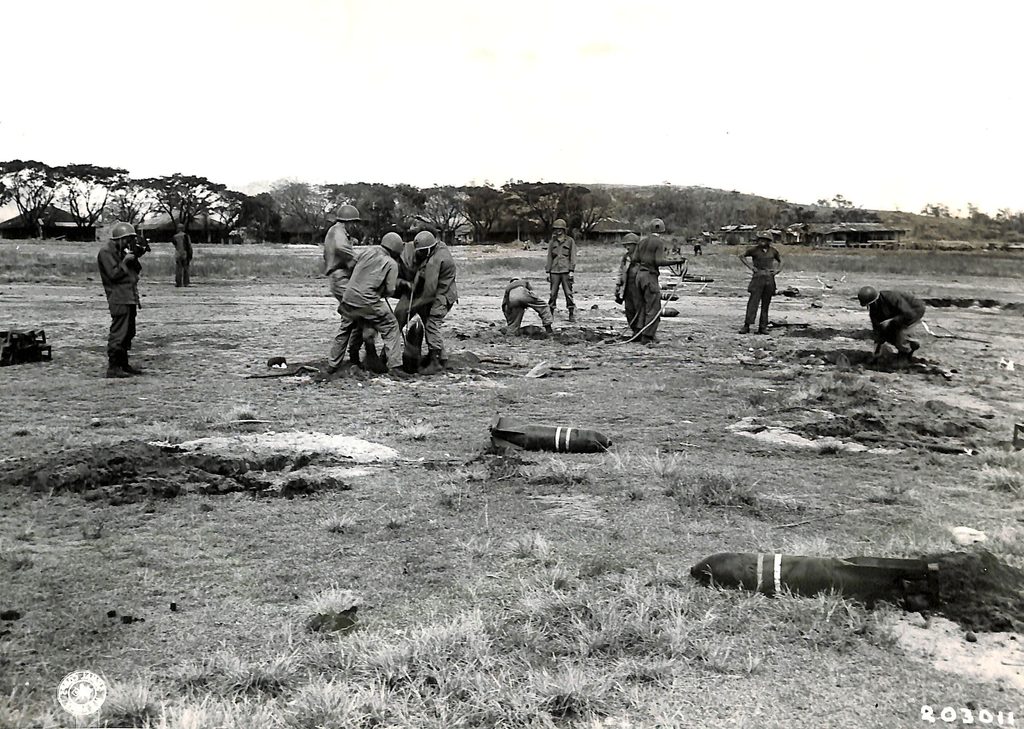
on January 31, 1945. Note the combat cameraman at the left of the image,
documenting the activity of the 117th Engineers.
US Army Signal Corps, NARA
The only remaining Eguchi Detachment forces were positioned on the western edge, holed on the fortified Top of the World behind the Parade Ground, where another week of brutal combat operations will be fought between the Eguchi and the 129th Infantry and 108th Infantry (40th Division).
Rhonie Dela Cruz
Bamban Historical Society/Bamban WWII Museum
Center for Pacific War Studies
WWII Remembrance Network – Hellships Memorial
PGT – Tarlac Provincial Tourism Office
SOURCES
a. The 37th Division in WWII.
b. Map Supplement to After Action Report M1
c. Operation, XIV Corps, Sketch No. 13 – Bamban Fort Stotsenburg, 24-January-1945 to 21-February-1945, Magalang 1944 3256 I.
d. Photograph No. SC 20311 “The 117th Engineers clearing mine fields at Clark Field, Fort Stotsenburg Luzon PI, January 31, 1945”, Signal Corps Photo, NARA.
After Action Report USS Hornet, Report No. 24, November 5, 1944 “Photograph No. 88”, Record Group 38, Records of the Office of the Chief of Naval Operations, NARA.