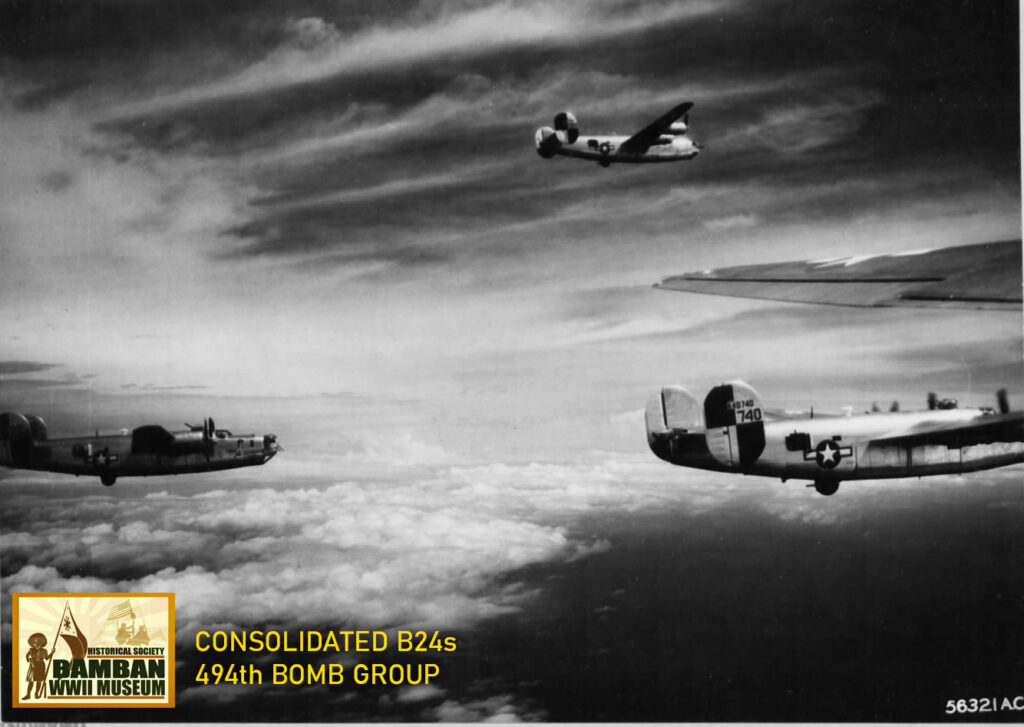
massive air raids around Clark Air Center in December 1944 and January 1945.
US NARA photo.
Investigating History:
THE AMERICAN AERIAL BOMBINGS OF JAPANESE-HELD CLARK FIELD: DECEMBER 24, 1944
(1944年12月24日、アメリカの飛行機
REMEMBERING THE BOMBING OF CLARK FIELD, DECEMBER 1944
We are enjoying the cold evening of Christmas and the upcoming New Year. Going back in time, during WWII, in one of the many aerial bombardments conducted by the American navy carrier planes and Army Air Force bombers at Clark Air Center, it was on Christmas Eve of 1944 when the Consolidated B24 from the 22nd Bomb Group (Heavy) did their job in dropping bombs on Japanese air assets and facilities. With then upcoming landing at Lingayen and ground operations for the invasion of Luzon by the Americans with General MacArthur, it was imperative for the American Air Forces to conduct massive air operations and neutralize Japanese air capability and destroy their air assets for the Liberation of Luzon.
CLARK AIRFIELD AND THE JAPANESE ARMY AND NAVY AIR FORCES
Clark Airfield was the biggest air facility of the Japanese Army and Navy air service in the Philippines during WWII. From the original air strip that was built by the Americans, several airfields were constructed at the Clark Proper, about 7 of them.
Clark was used extensively by the 4th Air Army and administered by the 10th Air Sector. With the start of the air campaign by the American Navy on September 21, 1944 and later with the activation of the Japanese Sho-Ichi-Go Operation, Imperial Japanese Navy 1st Air Fleet (Vice-Admiral Teraoka, later Vice-Admiral Ohnishi Takijiro) was mobilized in the area and on October 22-23, units of the 2nd Air Fleet (Vice-Admiral Shigeru Fukutome) begun arriving at Clark and nearby airfields of the Bamban, Mabalacat, Angeles, and Porac.
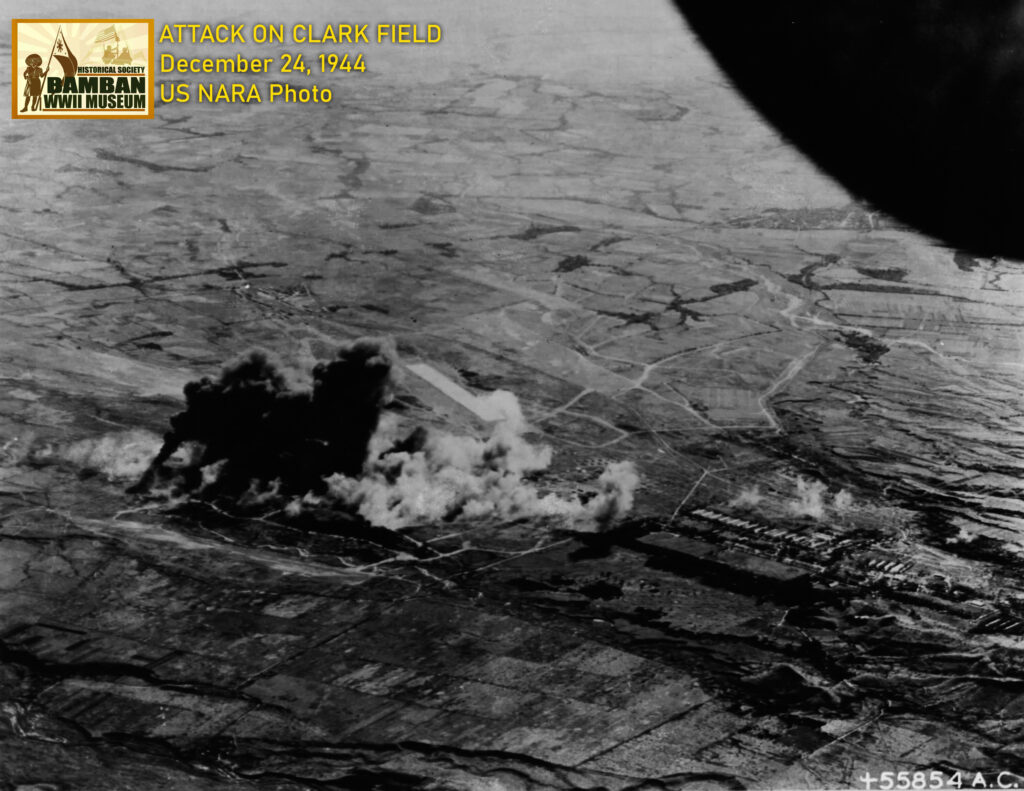
on December 24, 1944. Note the target was Lilly Hill and the aircraft revetments to the
left of the hill.
US NARA photo.
THE AIR CAMPAIGN AT CLARK AREA
The Imperial Japanese Army’s 30th Fighter Group was attached to the 4th Air Army (Lt. Gen. Kyoji Tominaga) and many of its units were mobilized at Clark area for operations in Leyte, Mindoro, and later at Lingayen. The air war over Clark intensified by late October. Aerial operations and bombardments were conducted by carrier-borne fighters and bombers mostly from USS Hornet, Wasp, Lexington, Intrepid, and Monterey, Cowpens. By December 1944, bombers from the 5th, 13th, 7th and 20th Air Forces begun conducting air operations on the airfields of Clark Center.
The air campaign was so effective that by the early January, 1945, there were few operational aircraft left and Clark area was littered with hundreds of wrecked airplanes. The strength of the Japanese 4th Air Army and the Navy’s 1st Combined Air Fleet was decimated.
CLARK RUNWAY NO. 3: DESTROYING THE AIR STRIP OF LILLY HILL
This is an important aerial photograph taken during the air bombardments of Clark Field, the image showing the extent of the coverage of the Japanese air strips constructed, including the Dau Airfield which is visible in the image. The prime target of the Consolidated B24s on this day, a particularly on the image taken as appearing are the aircraft revetments and taxiways in the vicinity of Clark No. 3 (Clark North), Clark No. 2 (concrete runway) and Clark No. 1 (longest air strip); with Lilly Hill, or the M201 Granite Hill as appearing on Japanese maps, as the center of air operations.
National Archives and Records Administration NARA provided details of the description of the image:
“Consolidated B24 (22nd Bomb Group) and North American B-25 and Douglas A-20s of the U.S. Army 13th, 5th and 7th Air Forces attack Japanese-held Clark Field on Luzon and other aerodromes in the Philippines in cooperation with the ground invasion. the American airmen shot down 104 Japanese planes and destroyed 252 on the ground. This is a view of one of the attacks on Clark Field.”
IDENTIFYING AIR STRIPS OF CLARK AIR CENTER
On the identification of the Japanese airfields at Clark and nearby Dau and Angeles, several maps were used including Japanese map made by Fumio Kawasaki, who was a pilot from the 95th Sentai, 5th Air Brigade (later transferred to 4th Air Brigade at Clark Margot Airfield in November 1944). The photograph of the bombing of Clark Field encompasses a panoramic view of all the Japanese air strips, Dau and parts of Angeles, thereby for the study of WWII History in the area, this identification photograph was made.
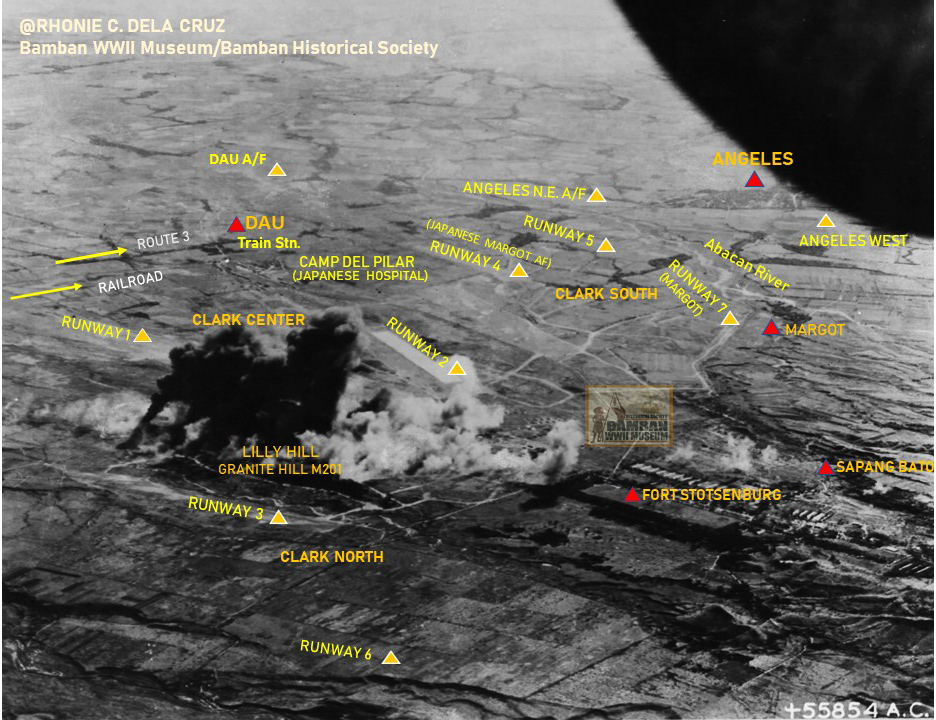
during the air raid by the 22nd Bomb Group.
B24-J LIBERATORS FROM 22ND BOMB GROUP, 5TH AIR FORCE
On the same day of the massive aerial bombardments on Christmas Eve 1944, there was another mission for the 22nd Bomb Group from the 5th Air Force, targeting Clark Field. Mission for the day was the Clark North Airfield (Clark No. 3), which was also bombed by the combined air assets of the 5th, 13th and 7th Air Forces. Consolidated B24-Js in large formation, conducted another aerial bombardment at the Clark North Airfield, hitting the runway, the point of impact of the bombings as appearing on the bursts of the bombs on the upper right of the runway.
CLARK NORTH AIRFIELD: IDENTIFYING LILLY HILL’s RUNWAY
Photograph shows the Clark North (Clark Runway No. 3), the runway on the right of the image, while the high ground the Japanese called M201 Granite Hill, based on available map provided by the late Moji Chikanori, is located parallel the air strip. Burst of bombs impacting the runway can be seen on the upper right of the air strip. However, many of the Japanese aircraft, probably Ki-43s, Ki-44s and Ki-61, appeared untouched with the bombings, on the left side of the road with Lilly Hill on the right. Between the runway and Lilly Hill is the stream. To the left of Lilly Hill, are massive air revetments used to hide numerous aircrafts from Clark North and Runway No. 1. Batteries of anti-aircraft guns are identified location in this image; on the upper left on the edge of the revetments, on the immediate upper left of Lilly Hill and on the right of Clark North airstrip, as marked .
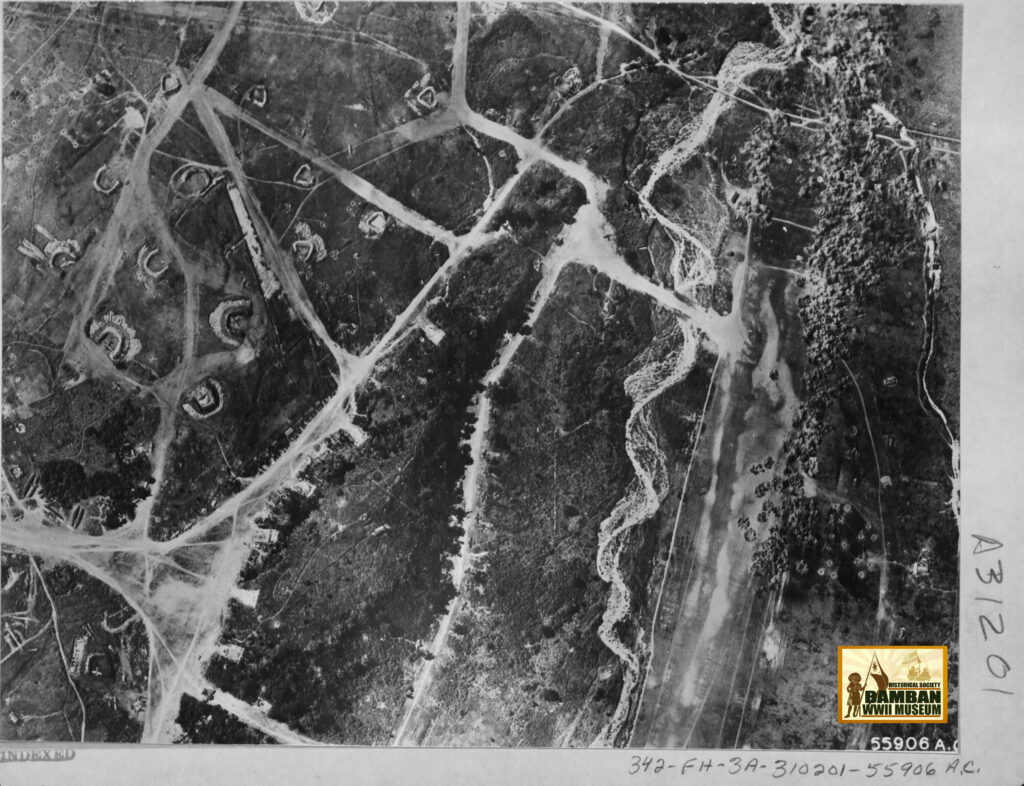
from the 5th Air Force (22nd Bomb Group), showing the impact of the bombs
on the upper portion of the runway.
US NARA Photo.
AMERICAN EAGLES AGAINST JAPANESE INTERCEPTORS
More than 50 Republic P-47 Thunderbolts from the 5th Air Force, probably based in Leyte, were airborne in support of the Consolidated B24-J missions at Clark Field on the same day with the 22nd Bomb Group. During the air raid over Clark Field, particularly the North Airfield, there were Japanese interceptors sortied against the American B-24Js, numbering 60, most probably K-43 Hayabusa, Ki-44 Shoki, Ki-61 Hien and the Mitsubishi A6M “Zero” or Zeke. The American B24-J heavy bombers along with the Republic P47s were responsible in shooting down 33 of the Japanese interceptors during dog fights above Clark Field on that day.
The massive aerial bombardments carried on Christmas Eve, Christmas and until late December 1944 at Clark and Mabalacat Airfields signaled the end of Japan’s capacity to conduct air war against the Americans. Japanese Kamikaze Special Attack missions were carried out from these airfields to Mindoro and later in Lingayen. It was just a matter of time that the beginning of the end of Japan’s air power in the Philippines had been felt with the continuous air raids over Clark Field.
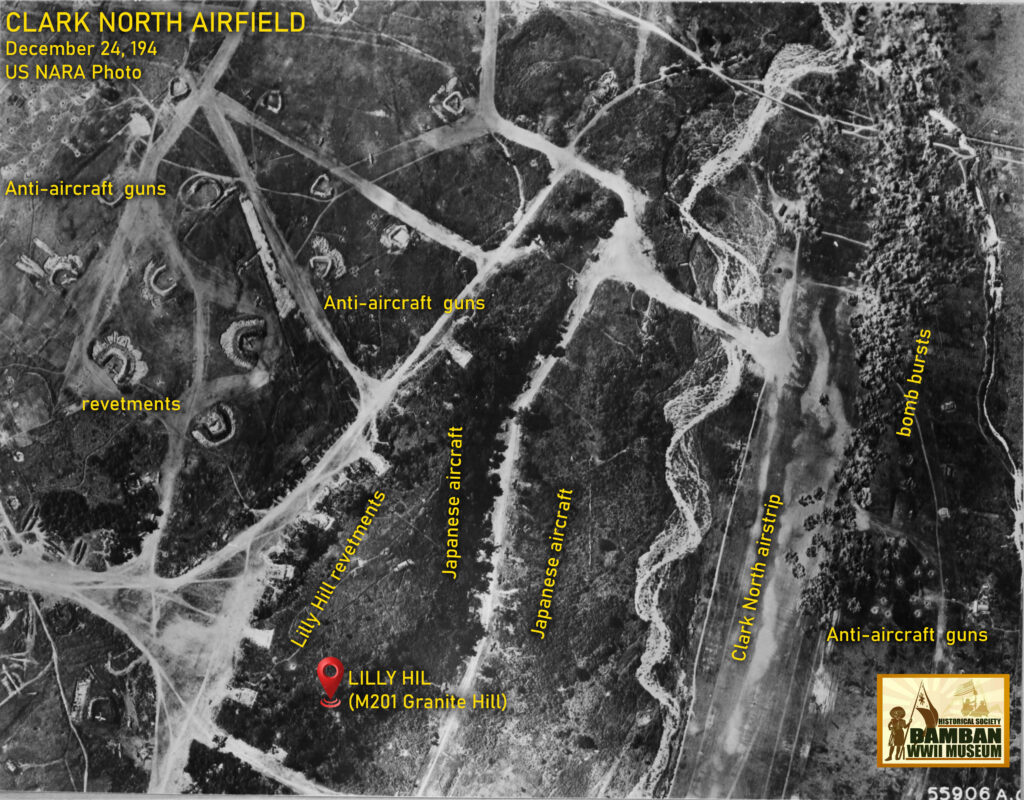
of the facilities, revetments, anti-aircraft and aircraft hiding place surrounding the
high ground.