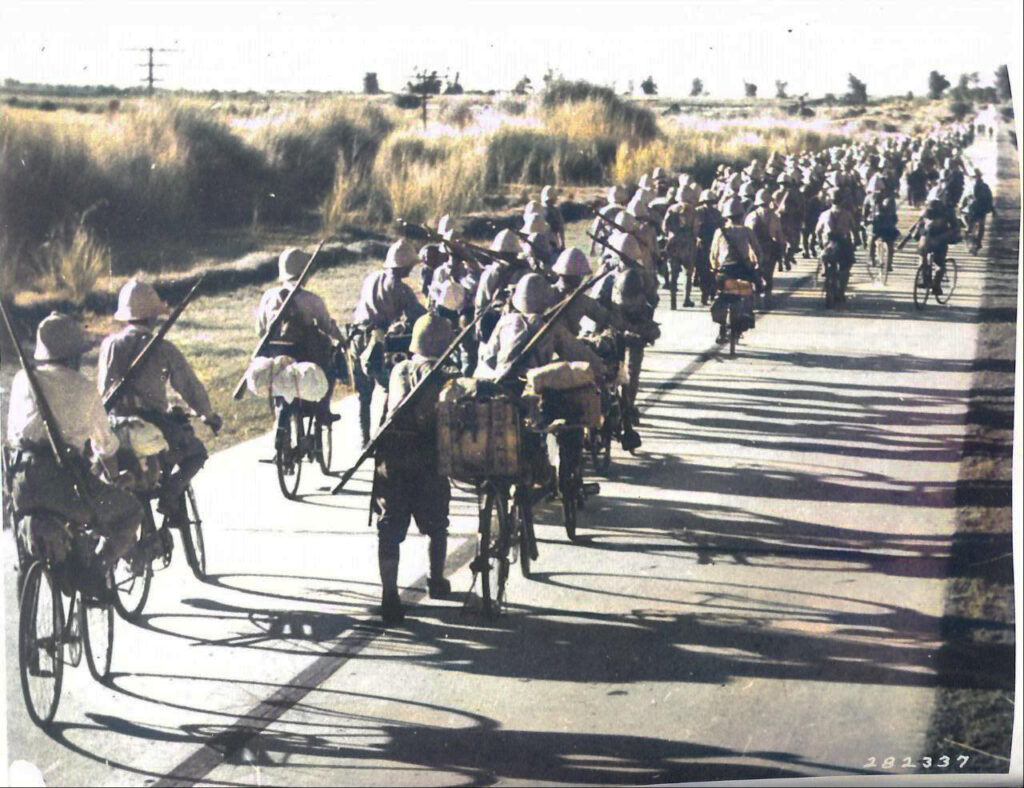
Tarlac, probably taken in Bamban, as cited in the History of the 21st Division. The same
advance troops were caught in the ambush by elements of the 21st Division defending Bamban
Bridge on December 31, 1941.
Investigating History:
HOLDING THE ROAD TO BATAAN: THE BATTLE FOR THE DEFENSE OF BAMBAN USAFFE D-5 LINE – DECEMBER 31, 1941 TO JANUARY 1, 1942 – 1941年12月31日から1942年1月1日にかけてバンバンでフィリピン軍と日本軍の間で戦闘が行われた。
BAMBAN, DECEMBER 1941 バンバン、1941年12月31日
Eighty years ago, Bamban marked its role in the defense of our Country during WWII as it silently observed New Year in those looming days of the war. At the time, there was blackout orders from the military and the town sank into darkness, as it was prohibited to light homes and streets, let alone the use of candles. Our grandfathers and uncles; sons of Bamban who were in the height of their teens heeded to the call to service for our Country and joined the Commonwealth Army, particularly the 21st Division, who would later be mobilized in the town to fight an invading army in their backyard. Others enlisted with the other units such as the 26th Cavalry PS, the 31st Division, 91st Coast Artillery PS, 301st Field Artillery PA, and other Philippine Scouts units at nearby Fort Stotsenburg such as the 23rd, 88th, 24th Field Artillery.
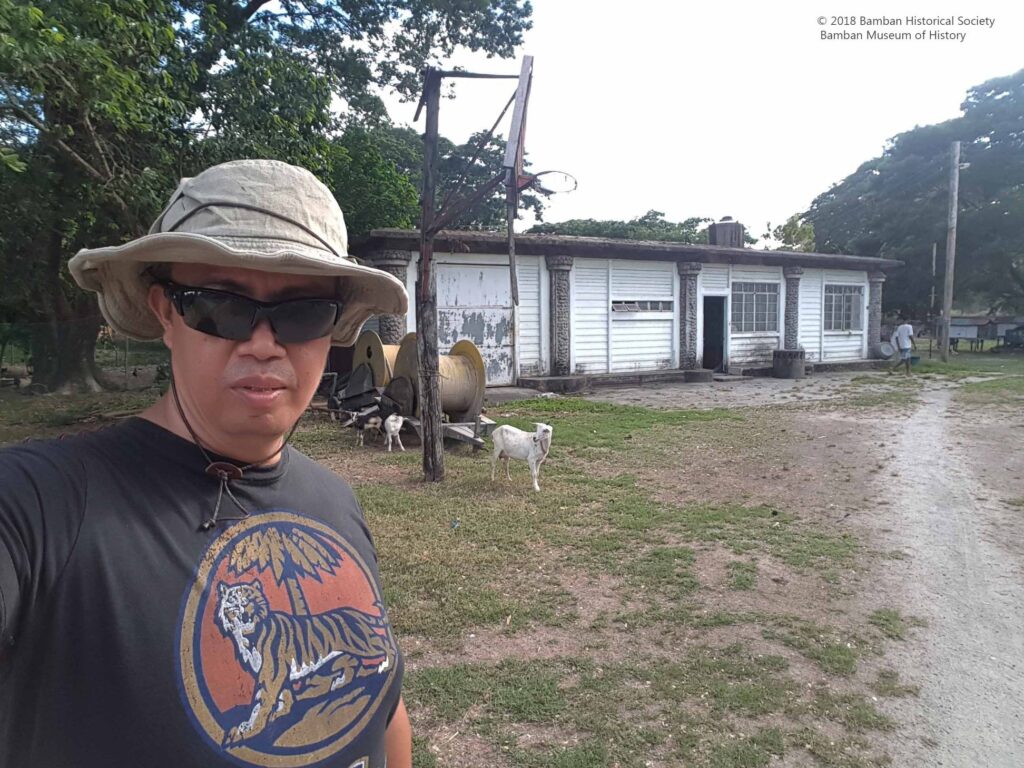
With the outbreak of the war and the subsequent bombings of Clark Field, Bamban had been of the strategic importance that would put her into an important role in the history of WWII. Major General Jonathan Wainwright, in command of the North Luzon Force, established his temporary HQ at the former Bamban Sugar Central on December 13, 1944 until December 16, due to incessant bombings of the Japanese at nearby Clark Field, bringing with him the squadrons of the 26th Cavalry PS bivouacked at the old Sugar Central. He used his trailer truck as his field headquarters, but the Sugar Central offered comfort facilities like the Club House where it was reported that the headquarters also used on the second floor. General Wainwright proceeded to the north to personally handle the combat operations against the Japanese, until the order of withdrawal from General MacArthur’s command was given, proceeding back to his Bamban HQ at the Sugar Central on Christmas Eve, until finally going south at Calumpit for preparations to Bataan Campaign.
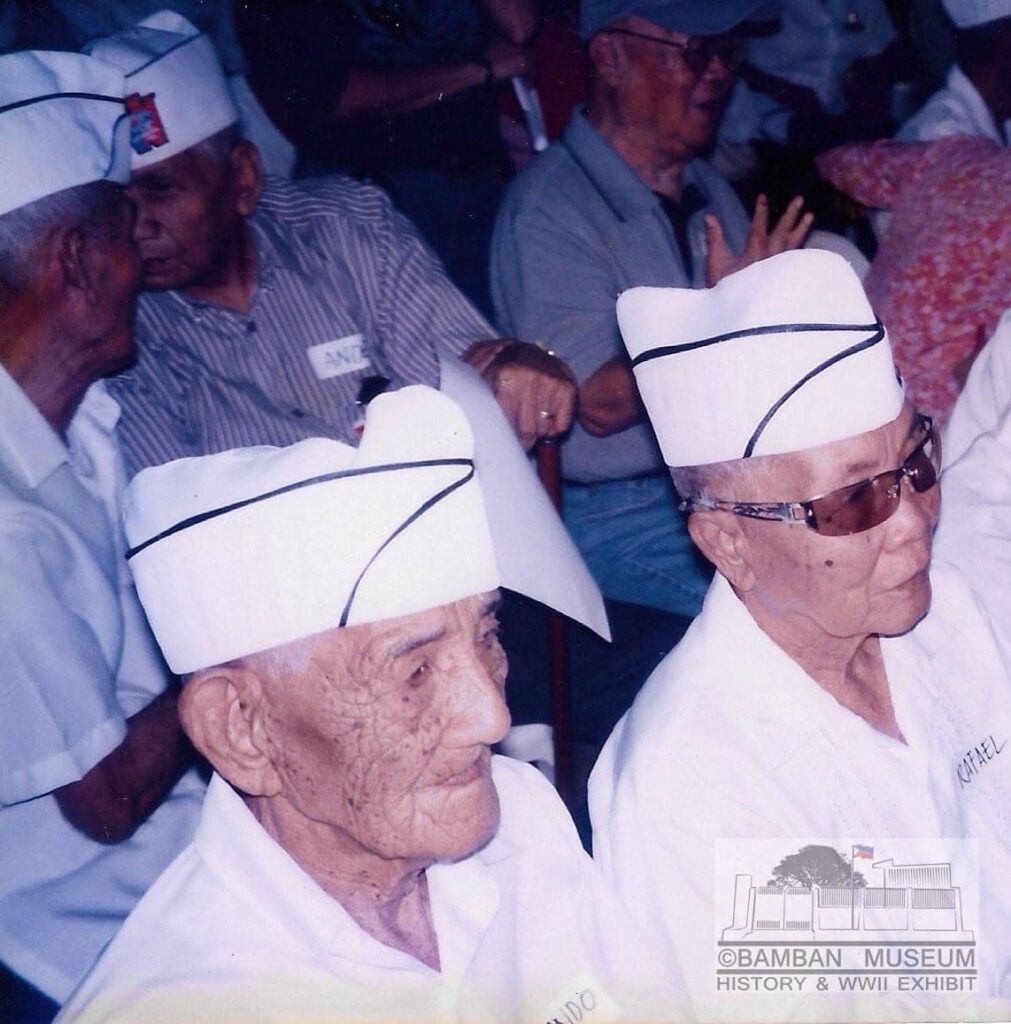
Philippine Army at the Bamban Line on December 31, 1941 and January 1, 1942.
Bamban Historical Society Collection.
THE FILIPINO-AMERICAN USAFFE DEFENSE LINE NO. 5 – フィリピン系アメリカ人米軍防衛ライン第5
On December 24, 1941, Major General Jonathan Wainwright mobilized in Lingayen issued the order to move back the Filipino-American forces of the North Luzon Force to Bataan, in compliance to General Douglas MacArthur’s War Plan Orange No. 3 in a retrograde movement with five designated Defense Lines stretching from the town of Aguilar in Pangasinan to Bamban, Tarlac. The latter was designated as the last defense line extending to the western outlines of the Bamban Hills overlooking the highway to include the ridge of the Bamban Sugar Central, crossing the river (southern riverbanks of the Bamban) and thence to Mt. Arayat extending to Sibul Springs in northern Bulacan. The 21st Division Philippine Army under the command of Major General Mateo Capinpin with the 11th Division under Major General William E. Brougher were to moved south on the western flank using the old Highway Route 3 (present MacArthur Highway) and Route 5. It was intended that the Bamban Line will be held by the 21st and 11th Division while the South Luzon Force pass the road to Bataan at San Fernando, Pampanga.
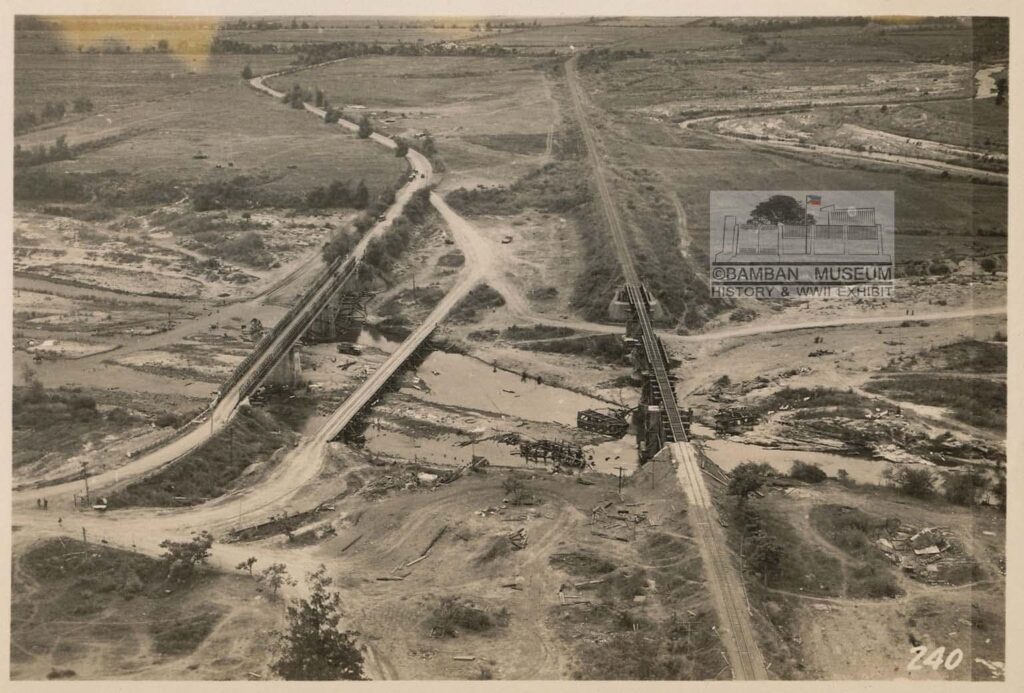
of the Bamban USAFFE D-5 Line.
40th Division US Army Photo, US NARA courtesy of Karon Thomas.
FILIPINO-AMERICAN FORCES MOBILIZATION TO BAMBAN LINE: DECEMBER 30-31, 1941 – フィリピン・アメリカ軍のバンバン線への動員:1941年12月30日~31日
From December 24 to December 28, the USAFFE Defense Line Nos. 1 to 4 were occupied by the North Luzon Force to slow down the Japanese Army’s advance towards the south. At the D-4 Line in Tarlac and Cabanatuan, the main Japanese forces that included tanks, infantry and cavalry engaged the valiant troops of the 91st Division and 21st Division; forcing General Wainwright to issue the order to move to Bamban Line on the night of December 30 and 31, 1941. The 26th Cavalry (PS) passed the road at Bamban where some of its townsfolk; Dominador Rongero and Melencio Figueroa of Troop B where able to check their families on their way to Porac. Bamban, a peaceful town of more than 6,000 people famous for its industrial base of the Central Luzon Milling Corporation (Bamban Sugar Central) located on the southern edge near the bridge was engulfed with the coming of thousands battered troops of the 21st Division where several of its infantry units will be posted on strategic locations along the banks of the shallow Bamban River in about 18-kilometer length.
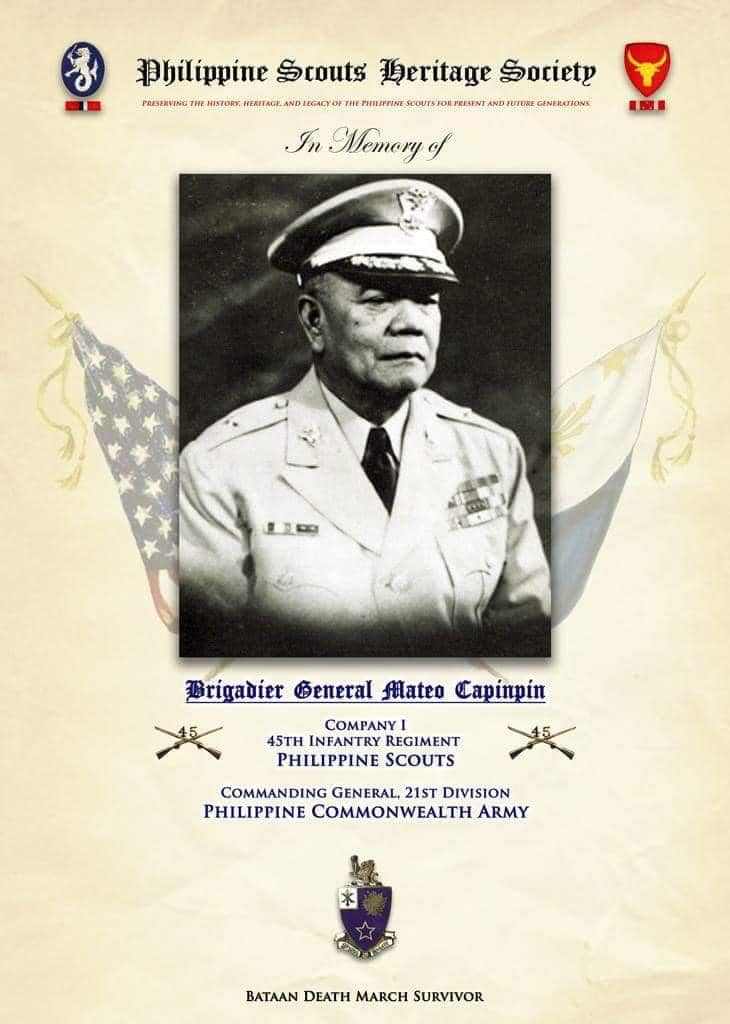
Photo by the Philippine Scouts Heritage Society.
BAMBAN BRIDGES – バンバン川に架かる車両と鉄道の鋼橋
Of particular importance on the road south was the high multiple four spans Bamban Railroad Bridge, raised 30 feet high above the ground level of the Bamban riverbanks supported by iron cylinders and 350 feet long that connects Tarlac and Pampanga provinces along the Manila-Dagupan Rail Line. The vehicular bridge was typical of its design in those days and was constructed during the American Period. Both bridges run parallel and separated by less than a hundred meters over the Paruao (Bamban) River. The Bantiti Hill-mass and the Bamban Sugar Central Mansion Ridge located north and northwest of the bridges provides strategic lookout for the defense of the entrances to the area.
THE FILIPINO-AMERICAN ARTILLERY FORCES AT BAMBAN LINE – バンバン防衛線のフィリピンとアメリカの砲兵部隊
With the infantry posted on both sides of the Bamban Bridge with the Bantiti Hills to the west and Lafe Hill to the south, 21st Division Artillery consisting of the 37mm anti-tank gun and a battery of self-propelled 155mm artillery were in position to provide the necessary firepower to protect the North Luzon Force at Bamban Line. The 21st Division Artillery was posted behind this line on the side of Mabalacat with its First Battalion near the river; the Second Battalion in the vicinity of the Dona Africa Hill east of Mabalacat and the Third Battalion near the old Barrio Dolores (now part of the Mabalacat Picnic Ground area). Aside from the 21st Division Artillery under Col. Nemesio Catalan, elements of the Provisional Field Artillery (Self-Propelled Mounts), with its Fifth Field Battery, Third Provisional Battalion armed with French 75-mm gun mounted on half-track scout car were also posted on the Bamban Line during the withdrawal from Tarlac D-4 Line.
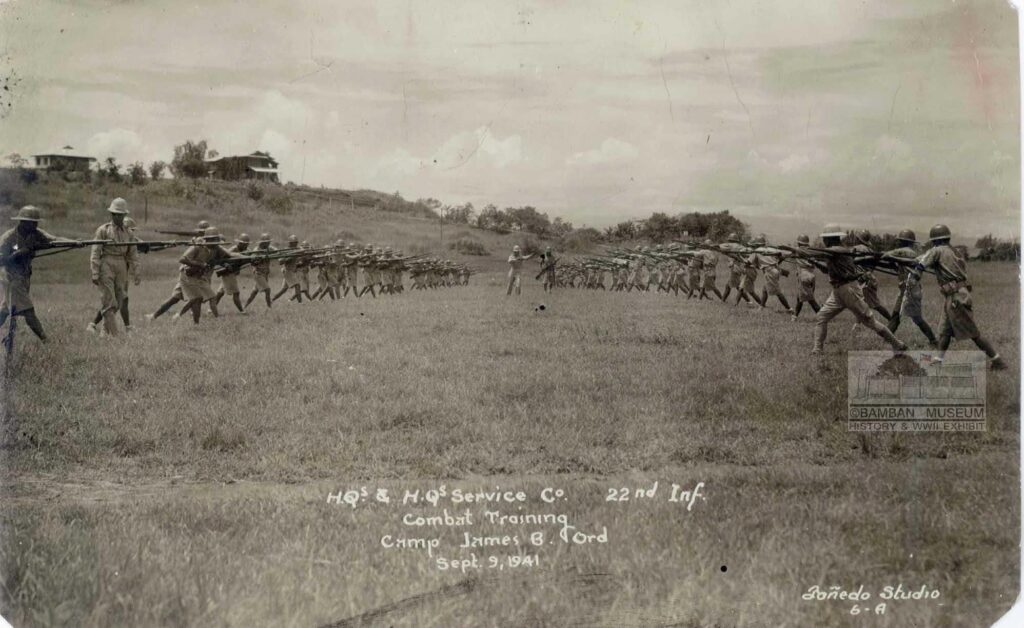
Camp James Ord (presently Camp Aquino), circa September 1941.
Credit to the owner of the photo.
THE 21ST INFANTRY DIVISION PHILIPPINE ARMY – フィリピン軍第21歩兵師団
Mobilizations of the 21st Division PA units to Bamban Line was not a smooth sailing, as the remaining troops of the battered First Battalion of the 21st Infantry were left stranded on the northern banks of the Bamban River after unloading by Pambusco buses coming out of the stiff fights in Carmen, Pangasinan. Second and Third Battalion of the 21st Infantry were also mobilized to provide infantry force in the Bamban Line near the bridge surroundings. The national highway known then as Route 3 was guarded by the 22nd Infantry under the command of Major Jose Aglamag. The entrance of the Bamban Bridge was likewise fortified with the installation of Special Combat Team of Company C (commanded by Major Espiritu), 23rd Infantry Regiment on the high ground north of the Bamban River on what is now the Mansion Ridge of the Bamban Sugar Central to provide infantry fire on the dominating grounds overlooking both vehicle and railroad bridges.
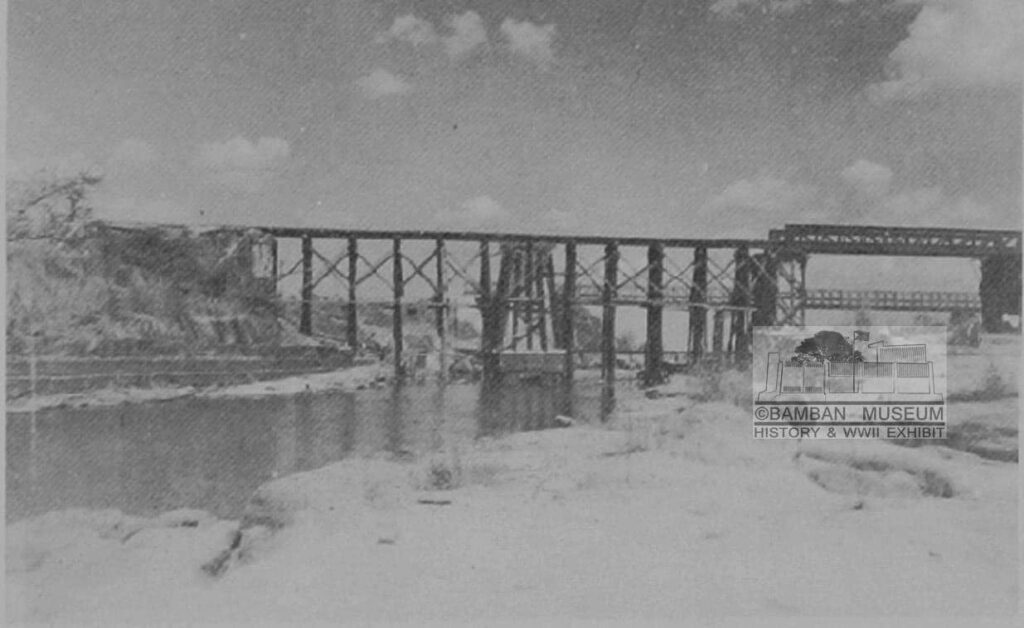
during the defense of Bamban Line. Photo taken in February 1945.
US National Archives Photo. Bamban Historical Society Collection
THE JAPANESE ARMY FORCES MOVING IN BAMBAN – バンバンに進軍する日本軍
With the outcome of the engagements with the 21st Division at Tarlac, the main body of the Japanese Imperial Army was the Kanno Detachment (with Col. Kanno in command) that came from Zaragoza (Nueva Ecija) debacle the previous days. The 9th Infantry who fought in Tarlac D-4 Line (its commanding officer, Col. Kamijima was killed during the battle) would provide infantry support for the Bamban Operations. The 8th Field Artillery (less one battalion), two batteries of the 22nd Field Artillery and a battalion of the 48th Mountain Artillery were tasked to provide artillery firepower in support of the operations and against the 21st Division Artillery. The Japanese Fifth Fighter Group was tasked to provide the necessary air support against the D-5 Line in Bamban after successive air operations in Tarlac Line.
DEMOLITION WORKS AND DESTROYING THE BAMBAN BRIDGE – バンバン橋の解体工事と破壊
On the evening of December 31, 1941, elements of General Capinpin’s 21st Division dynamited portion of the Bamban Bridge to prevent its use by the Japanese particularly tanks and other military vehicles. Prior moving to Bamban Line, the 21st demolition crew oversaw dynamiting bridges at Tarlac. Avelino Tuazon from Bamban was among the personnel of the Engineering Unit that conducted the demolition of the bridge as the North Luzon Force retreated south. Preparations for the defense of the Bamban Bridge was carried out with forward machine gun nests on the high ground overlooking the bridges, both sides of the entrances and inside the bridge, aside from the infantry units positioned in the vicinity with the artillery at the rear.
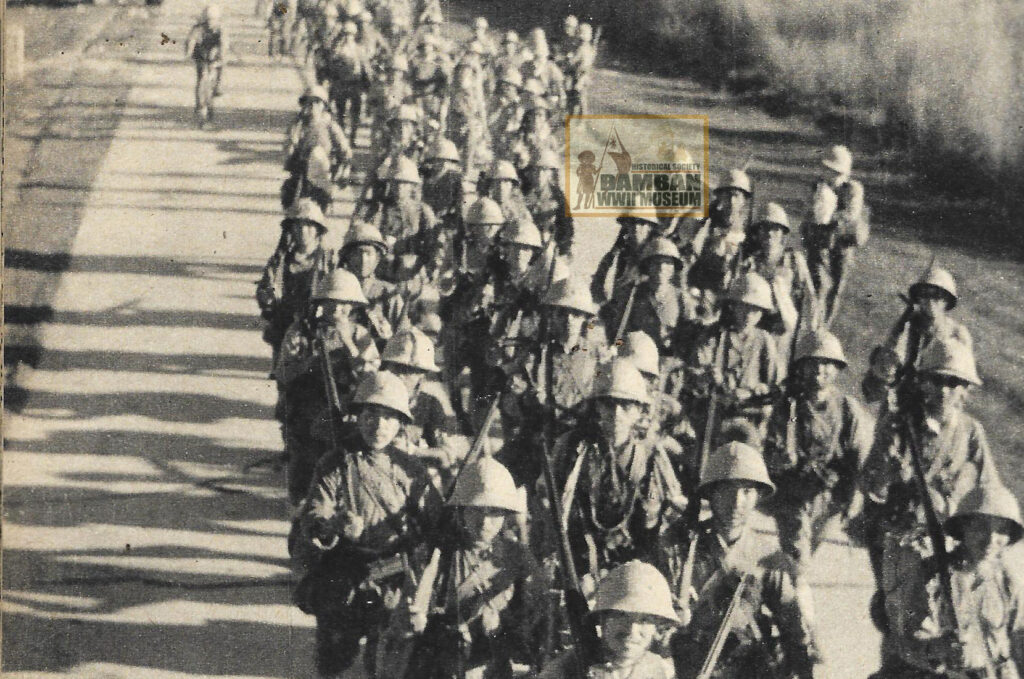
must had been the Bamban, early January 1945.
Bamban WWII Museum Collection
THE AMBUSH OF JAPANESE ADVANCE RECONNAISSANCE TROOPS, DECEMBER 31, 1941 – 1941年12月31日、日本軍先遣偵察部隊の待ち伏せ
As the town fell quiet on the night of December 31, 1941, the Japanese Imperial Army advance troops from the Kanno Detachment mounted in bicycles appeared in the north along the highway. By 10 p.m., as they move into the bridge entrance, volleys of rifles and machine gun fire ripped into the advance company of Japanese troops where the unit was annihilated in a successful ambush by the forward positions of Company C, 23rd Infantry. Among the troops of the 23rd Infantry was Private Rafael Yabut of Bamban who enlisted in the 21st Division along with other teenagers from the town during the general mobilization several months prior the outbreak of WWII.
DEATH OF LT. GREGORIO L. DE GRACIA AT THE BAMBAN BRIDGE – バンバン橋でフィリピン軍将校が死亡
After the successful ambuscades of the first Japanese advance troops at the Bamban Bridge, another Japanese infantry force of company-size in strength was mobilized to capture the important bridge facility. Lt. Gregorio L. De Grace commanded a machine gun platoon unit and was emplaced inside the bridge to counter any enemy crossing. At 1:30 a.m., the main Japanese Recon Troops moved into the entrance of the Bamban and a stiff encounter ensued with Lt. De Gracia’s machine gun platoon as well as the other infantry positions that provided fire support against the enemy. The Japanese Kanno advance troopers were killed to capture the strategic bridge while Lt. De Gracia was killed in the engagement; becoming the first officer casualty of the 21st Division during the Defense of Luzon.
NEW YEAR 1942 AND THE DEFENSE OF BAMBAN LINE – 1942年の新年とバンバン線の防衛
As the first light of the day in 1942 appeared, the Japanese main body of the Kanno Detachment mobilized in full force to break the Bamban Line. Japanese dive-bombers conducted air operations against the 21st Division infantry positions along the riverbanks while the guns of the Japanese field artillery units poured heavy shells on the southern banks of the Bamban. The 21st Division Artillery provided counter battery fire on the Japanese infantry positions located on the north of the town. The guns of the 48th, 22nd and 8th Field Artillery in support of the Kanno Detachment in Bamban were busy firing on the Filipino defenders of the Bamban Line for almost three-hour long artillery bombardment.
Tanks in support of the infantry appeared and tried to cross the ankle-deep Bamban River. The 21st Division Artillery anti-tank unit and the American Third Battalion of the Provisional Field Artillery (SMP) were quick to engaged and opened their guns on the Japanese tanks during the river crossing that destroyed them. At the same time, the Filipino-American artillery force fired their guns on the thousands of Japanese troops of the Kanno Detachment reinforced by the 9th Infantry located on the north side of the riverbanks of the Bamban where hundreds of bodies littered the areas. The Defenders of Bamban Line held their positions even in the face of artillery, infantry, tanks and aerial bombardment. By late afternoon, the order was issued by General Capinpin to start moving out of the Bamban Line. Late in the evening, the main body of the 21st Division in Bamban finally retreated out of the USAFFE Defense Line No. 5 and settled in position southwest of Porac for another delaying actions.
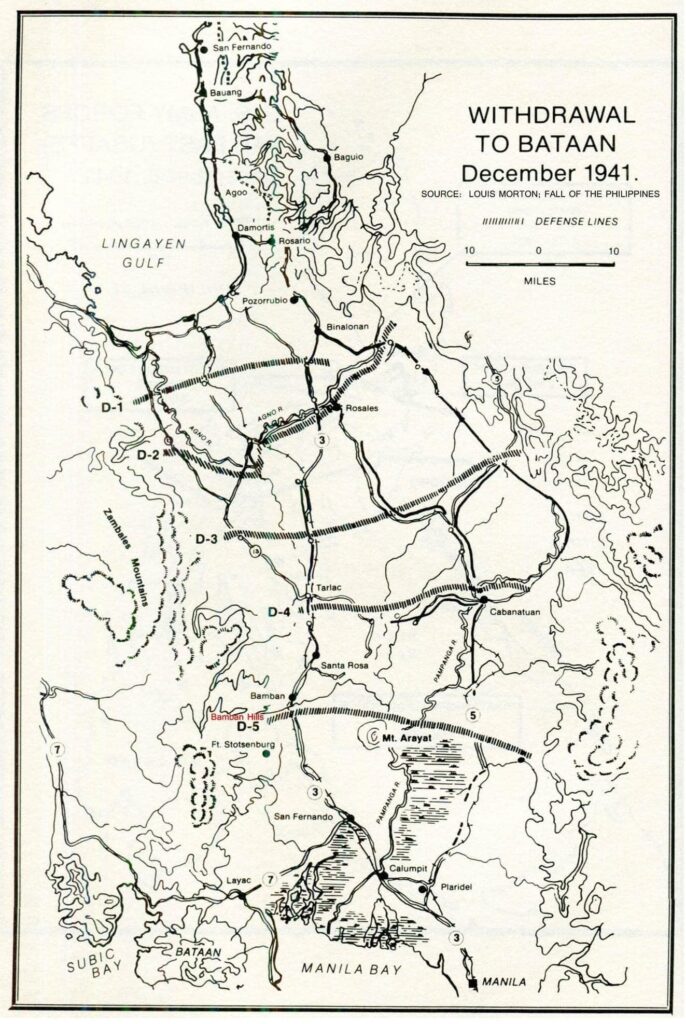
From: Louis Morton, The Fall of the Philippines.
The following is an account of the fighting at the Bamban D5 Line and the heroic stand of the Filipino-American forces taken after noontime on New Year 1942:
“Japanese dive-bombers were dumping 500-pound bombs on the 21st, and Homma’s heavy artillery pounded the entrenched defenders along the Bamban’s southern bank. After a three-hour long barrage, the Japanese cannons fell silent, and the planes veered away. Tanks plowed into the ankle-deep river and came at the 21st.
American artillery and anti-tank guns opened up. Within seconds shells slammed into several tanks. The impact yanked one into the air, and when it crashed back into the water the tank burst into flames. Flames enveloped several others.
Behind the tanks, several thousand Japanese infantrymen clotted the northern bank, and now the Allied artillery spewed one thunderous volley after another into the dense khaki mass. The explosions kicked up pewter-colored clouds above the river. As the smoke dissipated, hundreds of bodies were revealed on the bank. The rest of the throng had dive for cover in the brush. They did not reappear. Neither did the tanks.”
EPITAPH FOR THE MEMORY OF THE GALLANT FILIPINO DEFENDERS OF BAMBAN – バンバンの勇敢なフィリピン軍を偲んで
The Defenders of D-5 Line in Bamban were composed of the officers and men of the 21st Division and the artillery units mentioned that concluded the gallant stand on Bamban Bridge and the line in the riverbanks on the New Year of 1942 must not be forgotten. The fight was one of the successful engagements conducted by the Philippine Army during the early days of WWII in the Philippines. By holding the Bamban Line by our heroic defenders, North and South Luzon Force was able to slip into Bataan via the San Fernando and Porac Roads that paved the way for further preparations of the defense of Bataan.
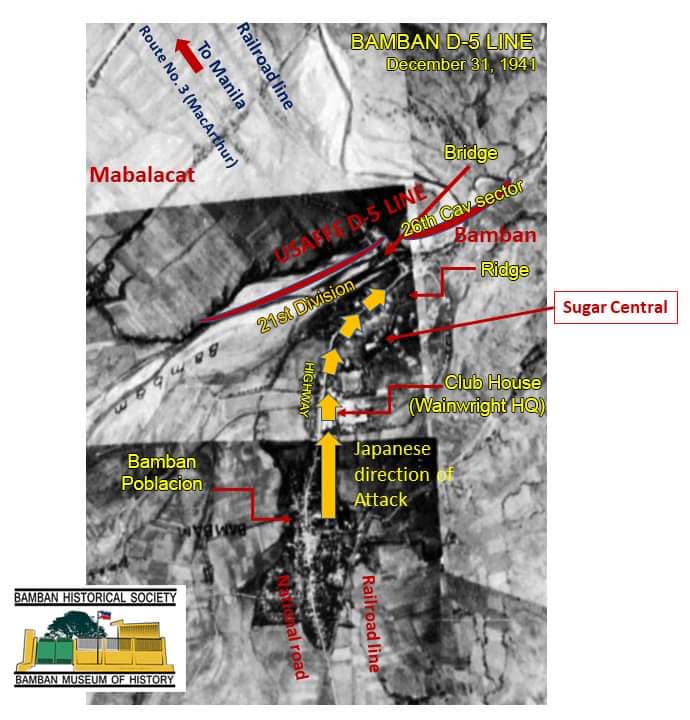
Showing the location of the 21st Division and the 26th Cavalry detached squadrons
posted on the southern banks of the Bamban River and the Bamban Line,
photo taken in 1944.
IN MEMORIAM – 記念に
Among the Defenders of the 21st Division was from Bamban; their deeds and sacrifices may not be forgotten in the annals of our WWII history of this town:
Eduardo Navarro
Rafael Yabut
Fernando Quiambao
Alejandro de Guzman
Alejandro Cadiang
Venerando Halili
Ciriaco Maristela
Sergio Noces
Rodolfo Vergara
PROPOSED 21ST DIVISION MEMORIAL AND MARKER AT BAMBAN BRIDGE – バンバン橋に第21師団陸軍記念碑と歴史標識を建設する計画
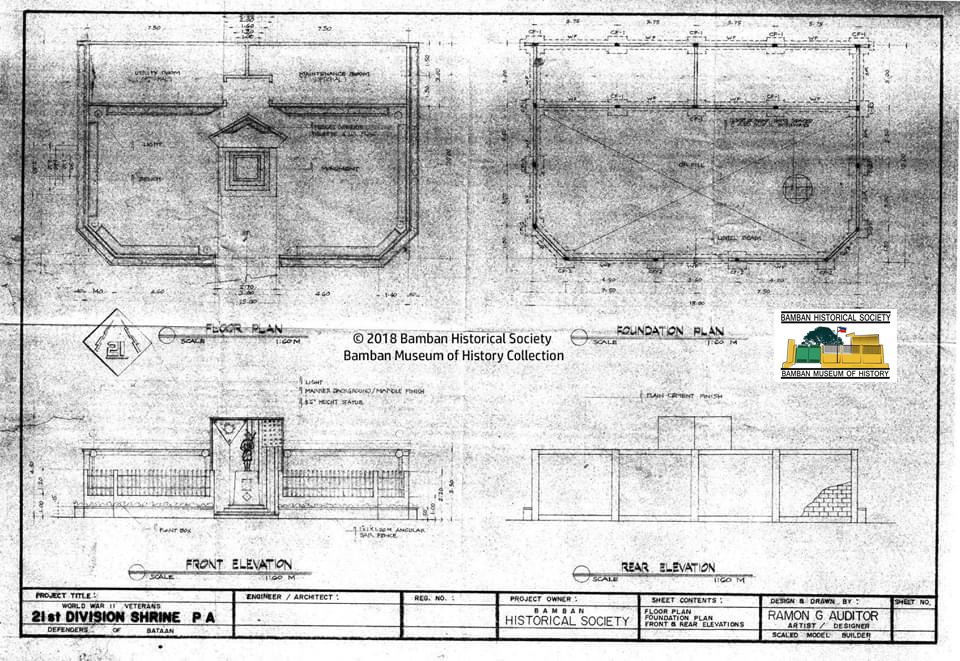
It is by us the living that we should not forget the legacy of heroism of our town’s WWII Heroes and the battle they participated and that a memorial to their gallantry should be established that their story shall me perpetually recognized and given importance that would give inspirations for the generations of Bambanenses and to instill love of Country and respect to our local veterans. Bamban Historical Society, as early as 2000 already made technical plans and drawings for the establishment of the 21st Division Memorial and the marker for the Defense of Bamban USAFFE D-5 Line near the present Bamban Bridge to honor the gallant stand of the 21st Division with the American instructors and the Provisional Field Artillery.
So, every December 31 and New Year, with the noise of the firecrackers as we welcome the coming of days, may we also remember the Defense of Bamban Line and our gallant soldiers who kept the fighting in the face of overwhelming enemy forces during WWII. In their memory.
Rhonie Dela Cruz
Museum Director and Historan
Bamban WWII Museum/Historical Society
Bamban Center for Pacific War Studies
WWII Remembrance Network – Hell Ships Memorial
PGT – Tarlac Provincial Tourism Office
CITATION
(1) Morton, Louis. US Army in WWII The War in the Pacific – The Fall of the Philippines. Commemorative edition. Center for Military History, United States Army: Washington DC, 1989.
(2) Stevens, Peter F. The Twilight Riders – The Last Charge of the 26th Cavalry. Connecticut: Lyons Press, 2011.
(3) Dioso, Marconi M. The Times When Men Must Die: The Story of the Destruction of the Philippine Army During the Early Months of World War II in the Pacific, December 1941-May 1942. Dorrence Publishing Company, 2010.
(4) Mallonee, Richard III. The Naked Flagpole – Battle for Bataan (From the diary of Richard C. Mallonee). San Rafael, California: Presidio Press, 1980.
(5) Reed, George R., The 3rd Field Artillery Battalion (Provisional) in the Philippines 1941-1942. US National Archives, Washington DC, 1948.
Interview
(1) Tuazon, Oscar. Interview by the author via online related to his father Avelino Tuazon who has taken part in the demolition works at Bamban Bridge on December 31, 1941, August 2, 2018.
(2) Yabut, Rafael. Interview by the author related to his exploits with the 23rd Infantry. Lourdes – Dapdap, Bamban, Tarlac, April 6, 2018.
PHOTOS:
(a) Photo of Rafael Yabut and Fernando Quiambao from Bamban, both served with the 21st Division PA at the Bamban Line on December 31, 1941 and January 1, 1942.
Bamban Historical Society Collection.
(b) Aerial photo of Bamban Bridges with the Paruao River. The site became part of the main defenses of the Bamban USAFFE D-5 Line.
40th Division US Army Photo, US NARA courtesy of Karon Thomas.
(c) Portrait of Major General Mateo Capinpin, Commanding General of the 21st Division PA during the defense of Bamban Line.
Photo by the Philippine Scouts Heritage Society.
(d) Soldiers of the 22nd Infantry Regiment, 21st Division PA during training exercise at nearby Camp James Ord (presently Camp Aquino), circa September 1941.
Credit to the owner of the photo.
(e) View of the railroad and vehicular bridges of the Bamban where the fighting took place during the defense of Bamban Line. Photo taken in February 1945.
US National Archives Photo. Bamban Historical Society Collection
(f) Map of the USAFFE Defense Lines with Bamban marked in the sector of the D-5 Line.
From: Louis Morton, The Fall of the Philippines.
(g) The ruins of the Bamban Sugar Central Clubhouse, where Gen. Wainwright and staff of the North Luzon also believed to be use as HQ in December 1941.
(h) Bamban USAFFE D-5 LINE, December 31, 1941
Showing the location of the 21st Division and the 26th Cavalry detached squadrons posted on the southern banks of the Bamban River.
Map by Rhonie Dela Cruz